

Are Your Tires Still Good? Here's How to Tell
Last modified on September 16th, 2026 in Tips & Maintenance
The short version
- Replace your tires once tread depth reaches 4.8 mm (6/32"), even though the legal limit is three times lower.
- Replace them after 5 to 7 years of use regardless of mileage, rubber dries out and loses grip.
- Uneven wear (on the shoulders, in the centre, or on one side only) almost always points to a pressure or alignment problem, not just age.
Everyone asks the same question sooner or later: will these tires make it through another season, or is it time to deal with it? Worn tires aren't just a budget issue. They're your only point of contact with the road, and thin tread means longer stopping distances and a higher risk of hydroplaning.
Here's how to check your tires in a few minutes, what uneven wear is telling you, and more importantly how to push back the day you have to replace them.
The 30-second check: the quarter test
You don't need special tools for a first diagnosis. Slide a quarter into one of the tread grooves, caribou nose pointing down:
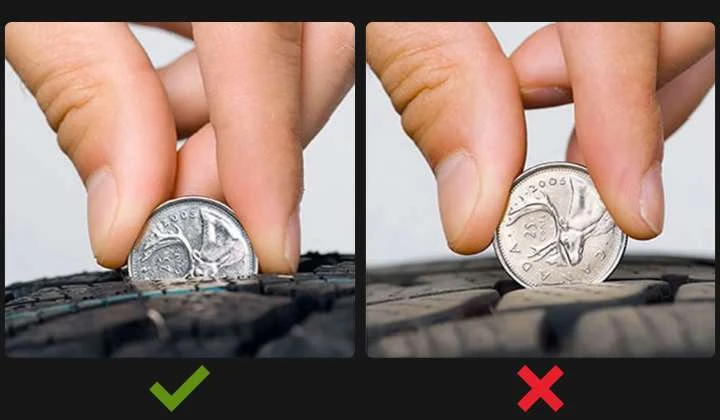
- The caribou's nose disappears completely? Your tread depth is still fine.
- The caribou's nose stays visible? Your tires are nearing the end of their useful life.
Repeat the test in three or four spots on each tire, and in different grooves. A tire can easily be fine on one side and too worn on the other, which is exactly what you want to catch.
The other method, even faster: wear bars.
Most tires have small raised bars moulded across the bottom of the main grooves. When the tread surface is flush with those bars, you've hit the legal minimum of 1.6 mm. At that point the tire needs to go, no debate.
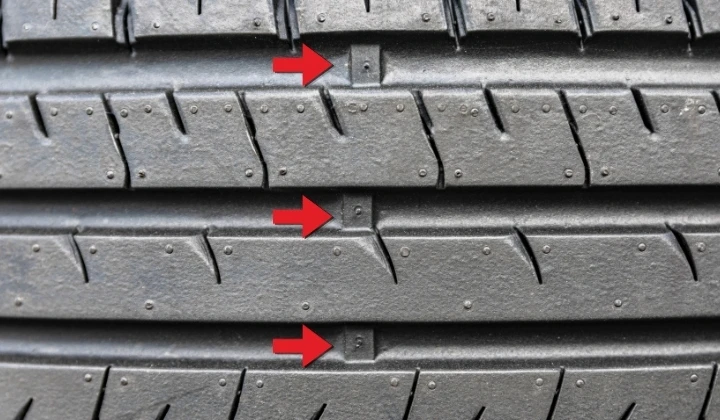
1.6 mm or 4.8 mm — which number actually matters?
The legal minimum across Canada is 1.6 mm (2/32"). That's the bare minimum the law tolerates, not a safety threshold.
For winter driving, tire manufacturers and safety organizations like CAA recommend at least 4.8 mm (6/32") of tread at installation time. Below that, tires stop clearing snow and water efficiently, and your braking distances stretch out well before the tire is technically "illegal."
Put another way: a tire at 2 mm is legal, but it doesn't have much left to give you in November.
4 uneven wear patterns worth recognizing
If your tires wear evenly, great. But uneven wear is never random, it's almost always points to an underlying mechanical issue that, left alone, will chew through your next set of tires too.
In short: shoulder or centre wear points to pressure, one-sided wear points to alignment, and cupping points to suspension or missed rotations. When in doubt, a quick inspection at a shop is the most reliable way to confirm the cause — and it's worth doing before you buy new tires, or the problem simply starts over.
Age matters as much as mileage
A low-mileage tire that's old can be just as risky as a heavily worn one. Rubber dries out over time, even in a heated garage, and loses grip. Fine cracks in the sidewall are often the first visible sign.
The general rule: replace your tires after 5 to 7 years of use, no matter how the tread looks. Past 10 years, replacement isn't negotiable, even on a tire that looks new.
How to read the DOT code
To find a tire's exact age, locate the DOT code on the sidewall and read the last four digits:
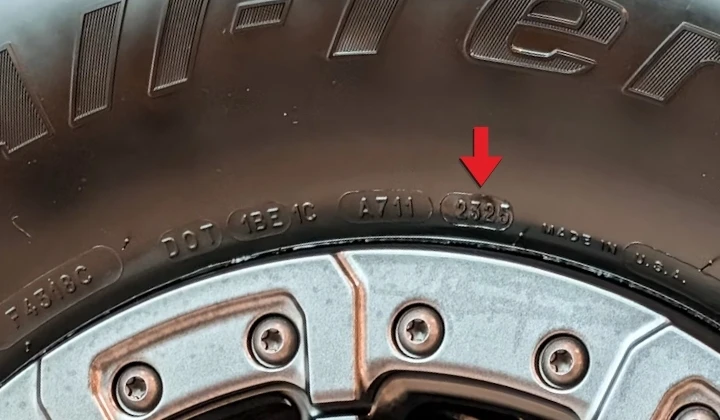
- The first two give the week of manufacture.
- The last two give the year.
A code ending in 2324, for example, means the tire was built in the 23rd week of 2025.
One useful detail: the full code is sometimes moulded on only one side of the tire. If you can't find it, check the other sidewall.
How long should a tire last?
It depends heavily on the type of tire, your driving style and your maintenance habits, but here are general benchmarks:
- Summer tires: roughly 40,000 to 80,000 km, or 3 to 6 seasons.
- Winter tires: roughly 30,000 to 50,000 km, or 3 to 5 seasons. Their softer compound wears a little faster.
- All-season tires: varies widely, but generally lands between the two, with a performance trade-off in extreme conditions.
Vehicle weight plays a real role too. Electric vehicles are heavier and deliver instant torque, so they tend to wear tires faster than a comparable gas vehicle. If you drive an EV, our article on tires for electric vehicles explains how to choose a model built to handle that accelerated wear.
5 habits that slow down tire wear
- Check your pressure monthly. Incorrect pressure (too low or too high) is the number one cause of premature and uneven wear. Check it cold, before you drive.
- Rotate at every seasonal changeover. It spreads wear evenly across all four tires, and since you're already at the shop twice a year, it costs almost nothing extra.
- Get your alignment checked. Especially after hitting a pothole or a curb, which is more or less a Canadian rite of passage.
- Adjust how you drive. Hard acceleration and heavy braking speed up wear, particularly on the front tires.
- Respect your vehicle's load rating. An overloaded vehicle, or one that tows often, wears through tires faster regardless of their quality.
When in doubt, check
Thin tread, uneven wear, or tires that are simply too old: three different reasons that lead to the same conclusion, it's time to shop.
That's especially true heading into winter, when demand spikes and the best sizes sell through first. Have a look at our article on why you should buy your winter tires in the fall to avoid the last-minute rush.
At Quattro Tires, our search-by-vehicle tool helps you quickly find tires that fit your car and compare technical specs so you can make an informed choice.
Frequently asked questions
What's the legal minimum tread depth in Canada?
The legal limit is 1.6 mm (2/32"). That said, manufacturers and safety organizations recommend replacing tires at 4.8 mm (6/32"), because grip starts dropping off well before the legal limit.
How can I tell if my tires are too worn without a tool?
Slide a quarter into a tread groove with the caribou's nose pointing down. If the nose stays visible, the tread is too thin and the tires need replacing. You can also check the wear bars moulded into the bottom of the grooves: if the tread surface is flush with them, the tire has reached the legal minimum.
Why are my tires wearing unevenly?
Uneven wear almost always comes down to a pressure problem (shoulder or centre wear), poor alignment (one-sided wear), or suspension that needs attention (cupping).
Do I need new tires even if there's tread left?
Yes, if they're more than 5 to 7 years old. Rubber dries out and loses grip over time, even when tread depth still looks acceptable. Check the last four digits of the DOT code on the sidewall for their exact age.
Can I replace just two tires?
You can, but the two new tires should go on the rear axle, even on a front-wheel-drive car, it reduces the risk of oversteer on wet roads. Replacing all four at once is still ideal for balanced handling.